

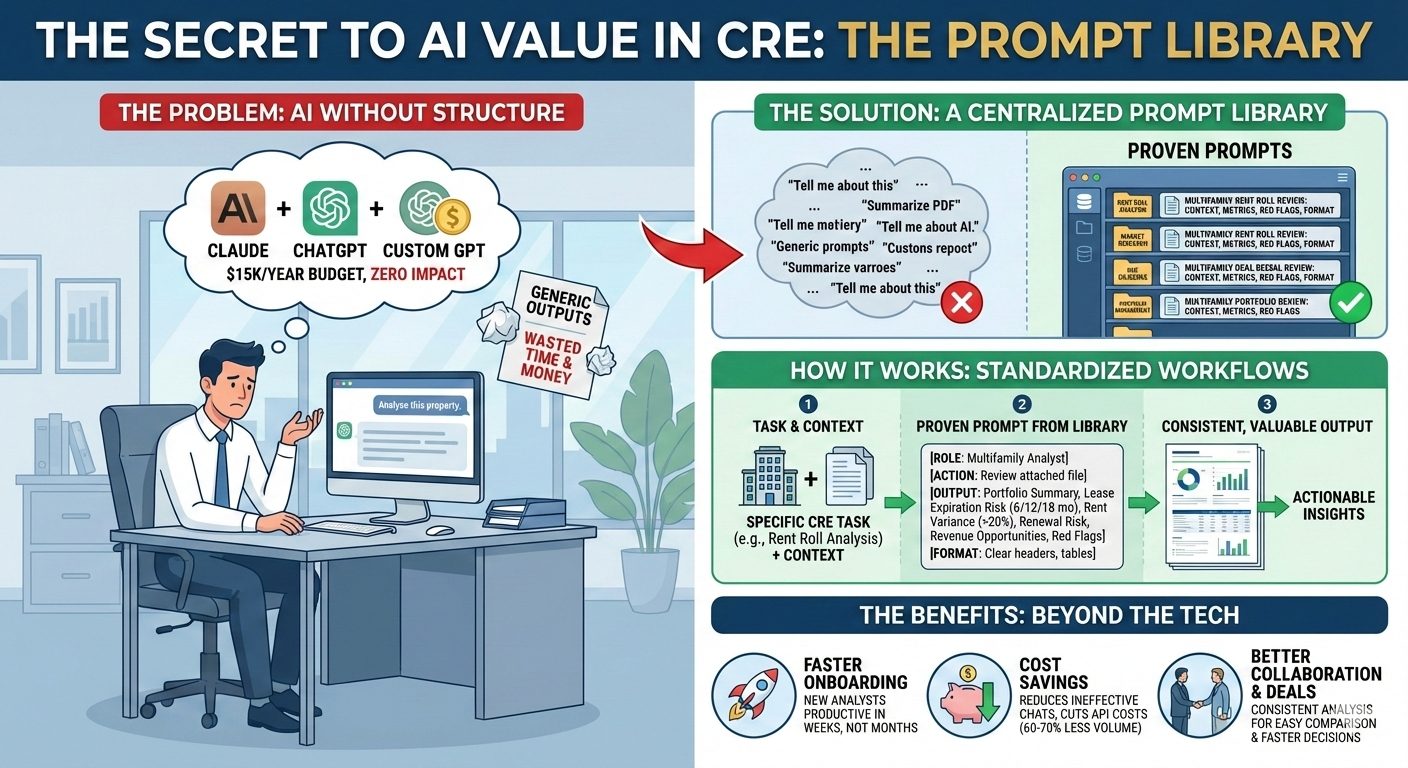
The head of acquisitions at a mid-sized investment firm called with a problem I’ve heard a hundred times. His team had access to Claude, ChatGPT, and a custom GPT they’d paid a consultant to build. Total AI budget: $15,000 per year. Total impact on their workflow: basically zero.
“The technology doesn’t work for real estate,” he told me. “We tried using it for due diligence, and the outputs were terrible.”
I asked him to show me exactly what his team was sending to the AI. He pulled up a chat history. The last prompt from one of his analysts read: “Analyze this property.”
That was it. No context. No structure. No specific ask. Just “analyze this property” with a 50-page PDF attached. And then they were surprised when the AI came back with a generic summary that could have applied to any property in any market.
The problem wasn’t the technology. The problem was that nobody had taught his team how to use it.
The Prompt Library: Your Secret Weapon
Here’s what I’ve learned after implementing AI at dozens of CRE firms: the difference between teams that get value from AI and teams that don’t has almost nothing to do with which models they use. It has everything to do with whether they have a shared library of proven prompts.
A prompt library is exactly what it sounds like: a centralized collection of prompts that your team has tested, refined, and validated for specific tasks. Think of it like a deal playbook, but for interacting with AI.
Instead of every analyst reinventing the wheel each time they need to analyze a rent roll, they go to the prompt library and use the “Rent Roll Analysis” prompt that someone already perfected. Instead of guessing how to ask for market research, they use the “Market Overview” prompt that consistently delivers good results.
What Goes In A Prompt Library
A good prompt library should cover the workflows your team actually does every day. For most CRE firms, that includes:
Due Diligence:
- Rent roll analysis
- Operating expense review
- CapEx reserve analysis
- Lease abstract summaries
- Environmental report summaries
- Title commitment review
Market Research:
- Submarket demographic snapshots
- Competitive property analysis
- Economic and employment trends
- Development pipeline summaries
Deal Execution:
- LOI drafting
- Investment committee memo sections
- Executive summaries
- Risk factor identification
- Sensitivity analysis setup
Portfolio Management:
- Lease expiration reports
- Property performance dashboards
- Budget variance analysis
- Tenant retention analysis
For each of these tasks, you want 2-3 proven prompts that your team can copy, customize, and use.
A Real Example: Rent Roll Analysis
Here’s what “analyze this rent roll” looks like when it’s actually engineered properly:
Basic Prompt (Doesn’t Work Well):
“Analyze this rent roll and tell me what’s important.”
Prompt Library Version (Actually Useful):
“You are analyzing a rent roll for a multifamily acquisition. Review the attached file and provide:
Portfolio Summary: Total units, occupied units, occupancy rate, total monthly rent, average rent per unit, average rent per square foot
Lease Expiration Risk: Number and percentage of leases expiring in the next 6 months, next 12 months, and next 18 months. Flag if more than 30% of units expire in any 12-month period.
Rent Analysis: Identify the range from lowest to highest rent per unit. Calculate the median and flag any units more than 20% above or below the median. Are there any vacant units that were previously rented at significantly different rates?
Renewal Risk: Identify any tenants with month-to-month leases. How many units are these, and what percentage of total income do they represent?
Revenue Opportunities: Based on the distribution of rents, what is the potential upside if we bring below-market units up to the median rent? Show this as annual dollar impact.
Red Flags: Call out anything unusual – units marked vacant but showing income, duplicate lease numbers, missing move-in dates, lease terms longer than 18 months, or any other inconsistencies.Format your response with clear headers for each section and use tables where appropriate. Be specific and quantitative.”
See the difference? The second prompt tells the AI exactly what you need, in what format, and what level of detail. It gives context (multifamily acquisition). It provides specific thresholds (30% lease expiration concentration, 20% rent variance). It asks for both summary statistics and red flag analysis.
When you use the second prompt, you get output that’s immediately useful. When you use the first prompt, you get nothing.
- Join the CRE Agents waitlist today to skip the trial-and-error and start working with digital coworkers who come pre-loaded with proven commercial real estate prompt libraries.
Building Your First Prompt Library
You don’t need to build the whole library on day one. Start with the three most common tasks your team does, and create one really good prompt for each.
Here’s how:
- Identify the task. Be specific. Not “financial analysis” but “operating expense review for multifamily properties.”
- Define the output you want. What does success look like? A summary paragraph? A formatted table? A bulleted list of issues? Be explicit.
- Test and refine. Have three different people on your team use the prompt on three different properties. Did they all get useful results? What did the AI miss? What did it include that you don’t need?
- Document and share. Put the final version in a place everyone can access – a shared Google Doc, a Notion page, your internal wiki. Include a note about when to use this prompt and an example of good output.
- Iterate over time. As your team uses the prompt, they’ll discover edge cases and improvements. Update the library version.
The Instant Onboarding Benefit
One of the hidden benefits of a prompt library is that it makes onboarding new team members dramatically easier. Instead of spending weeks teaching a new analyst how to review rent rolls or research submarkets, you hand them the prompt library and say, “Here’s how we use AI for common tasks. Start here.”
They’re immediately productive. They don’t have to figure out what questions to ask or what format you expect. They just use the prompts that already work.
I’ve seen this cut onboarding time for junior analysts from 3 months to 3 weeks.
The Cost Savings You’re Not Tracking
Here’s a dirty secret about AI implementation: most firms are spending way more money than they need to because their team is using AI inefficiently.
When you send a poorly constructed prompt, you get a mediocre response. So you send a follow-up prompt to clarify. Then another to get it in the right format. Then another to add something you forgot. By the time you’re done, you’ve had a 20-message conversation to accomplish something a single good prompt could have handled.
Those messages add up. If you’re on a usage-based pricing model (which most API-level implementations are), you’re literally paying for your lack of prompt engineering.
A prompt library cuts your message volume by 60-70% because you get the right output on the first try. Over a year, for a team of 10 people using AI daily, that’s easily $3,000-5,000 in savings.
Collaboration Gets Better Too
When everyone’s using different prompts for the same tasks, the outputs are inconsistent. One analyst’s rent roll summary looks nothing like another analyst’s rent roll summary. Your managing director gets frustrated because they can’t compare deals side-by-side.
A prompt library creates consistency. Every rent roll analysis follows the same structure. Every market overview includes the same categories of information. Your MD can review 10 deals in the time it used to take to review 3 because everything’s formatted the same way.
The Bottom Line
Before you pay for another AI model, before you hire a consultant to build you a custom solution, before you complain that “AI doesn’t work for real estate,” build a prompt library.
Start small. Three prompts for three common tasks. Test them. Refine them. Share them. Add more over time.
You’ll be shocked how much more value you get from the AI tools you already have. And you’ll save a fortune by not chasing shiny new models that won’t solve your real problem.
The firm I mentioned at the start? After I helped them build a prompt library, their AI usage went from “occasionally, when we remember” to “every single deal.” Their analysis quality improved. Their deal timelines shortened. And they didn’t spend an extra dollar on technology.
That’s the power of actually using the tools you already have.
Frequently Asked Questions About Building A CRE Prompt Library
The best approach is to assign one person on the deal team, not IT, as the prompt library owner. They do not need to write every prompt themselves. Their job is to collect what is working across the team, standardize the format, test new prompts against real deals, and update the library as workflows and tools evolve. Without a clear owner the library goes stale within a few months and people drift back to ad hoc prompting.
A well-structured prompt will work across most major models like Claude and ChatGPT with minor adjustments. The key elements that transfer are clear context, specific output format, defined thresholds, and explicit instructions about what to flag. You may need to tweak language slightly for each model, but roughly 80 to 90 percent of a good prompt carries over. That is why investing in prompt quality pays off regardless of which tools you use today or switch to later.
Your prompt library should include clear rules about what data can and cannot be sent to which tools. Many firms use enterprise-tier AI subscriptions that do not train on your data and offer data processing agreements. For highly sensitive documents, some firms redact identifying details before sending or use on-premise models. The prompt library is actually the right place to document these guardrails so every team member knows the rules before they paste anything into a chat window.