
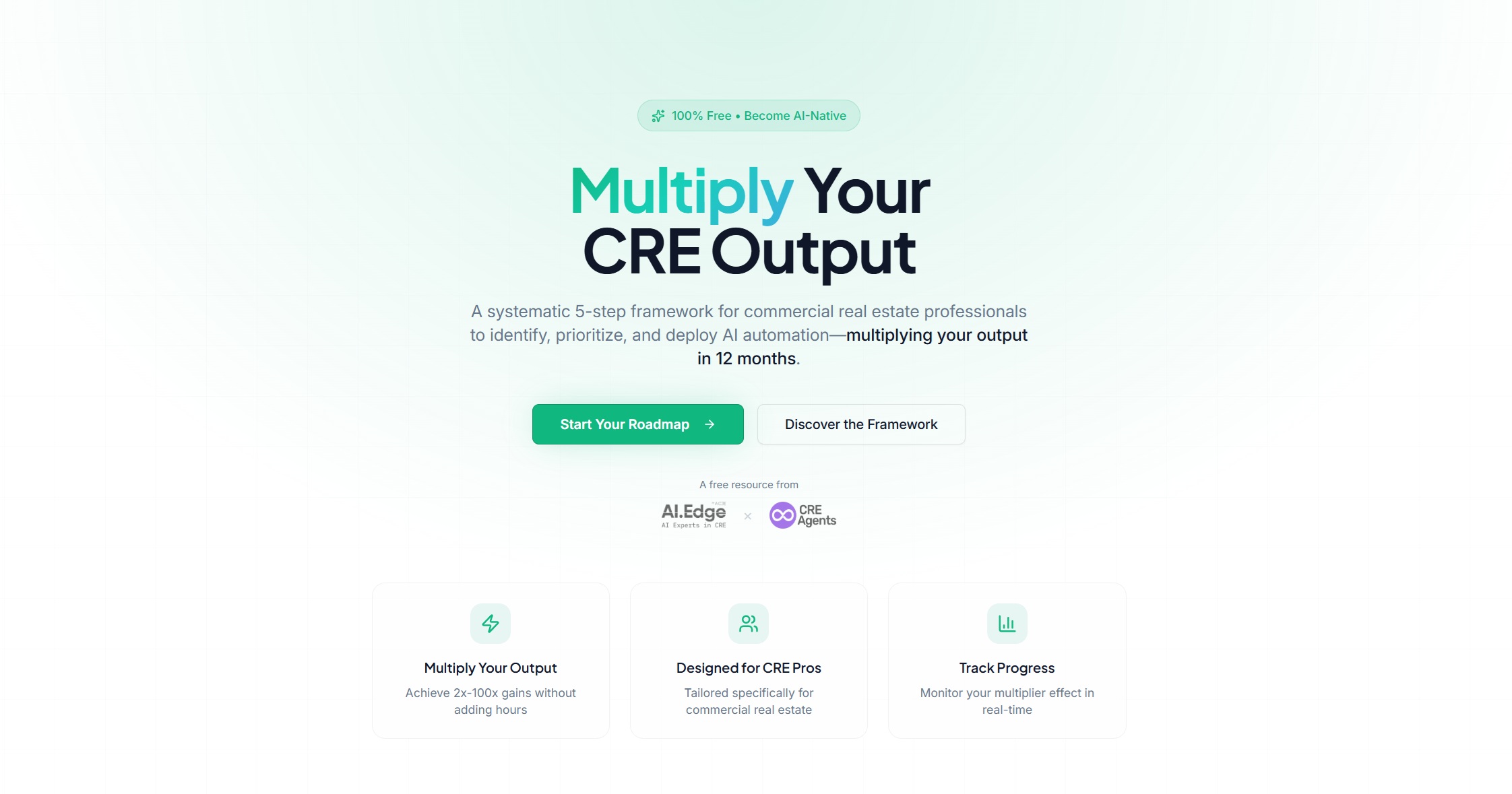
On January 15, more than 700 commercial real estate professionals joined me live (out of nearly 1,400 registrants) to learn one simple idea:
Any CRE professional can multiply their output, regardless of how “technical” or “AI savvy” they feel today.
Not by grinding longer hours or hiring a bigger team. Instead, by taking a clear, disciplined look at the work that actually stands between you and your results, then using AI and automation to compress that work into a fraction of the time.
If you were not able to join live, or you want to go deeper, this post will give you:
- The full 90-minute workshop replay
- A straightforward walkthrough of the five-step Multiplier Framework
- A link to the Multiplier Framework app, a free tool we built so you can apply this in your own shop
- Pointers to AI.Edge and CRE Agents if you want to keep learning and start building custom solutions
Watch the 90 Minute Workshop Replay
Note: After you click through to the replay page, scroll about halfway down to find and download the slide deck used in the session.
Use the Multiplier Framework App (Free)
Link: https://multiplier.adventuresincre.ai/
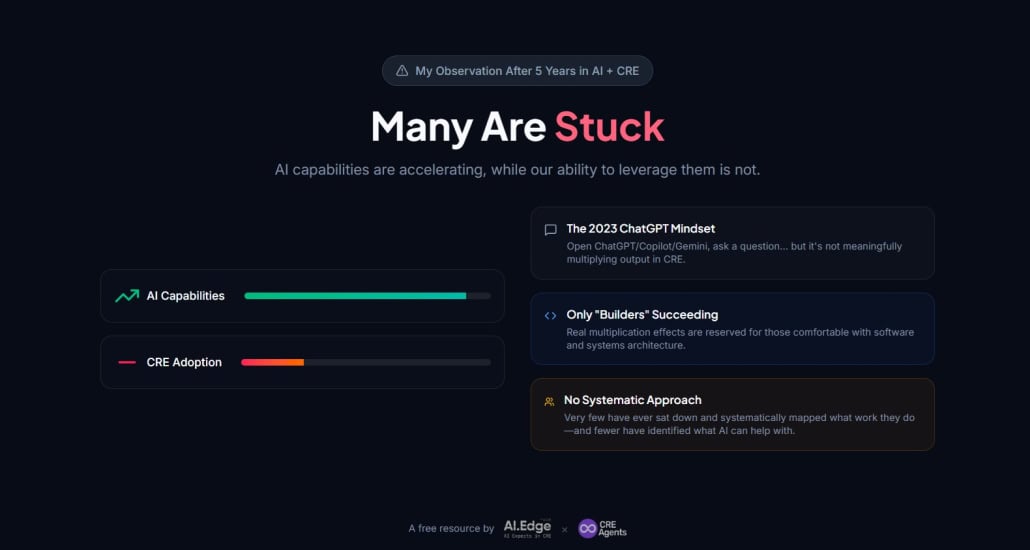
Why So Many CRE Pros Are Still “Stuck in 2023”
During the workshop we ran a quick poll. Over 70 percent of attendees said they use AI only occasionally, and with no real system behind it.
Most people are still in a 2023 ChatGPT mindset:
- Use AI chat as a slightly smarter search engine
- Ask it to draft an email, memo, or summary from time to time
- Get burned once or twice by hallucinations
- Then mostly stop pushing forward
Meanwhile, the tools have quietly moved ahead. Today, AI can:
- Monitor inboxes and channels
- Parse offering memorandums and financials
- Trigger and manage workflows
- Move data between systems and spreadsheets
- Draft, revise, and re draft analysis as assumptions change
In other words, AI can now participate in real work, not just answer questions in a chat window.
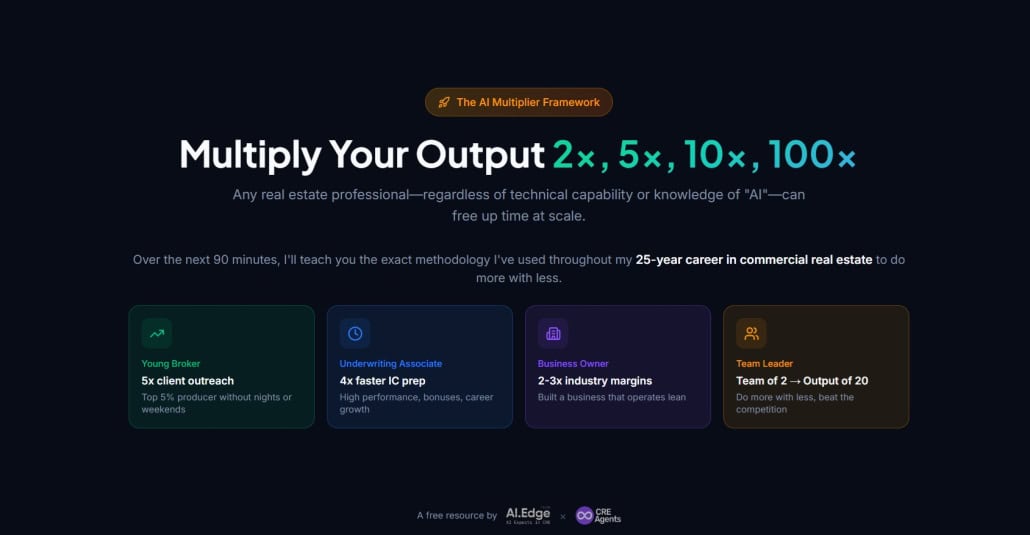
Throughout my career, some version of the Multiplier Framework has helped me:
- As a young broker, reach roughly five times as many prospective clients
- As an underwriting associate, prep for IC in about one quarter of the time my peers spent
- In my current business, double margins
- At Stablewood, help a team of 2 produce work equivalent to a team of 20
The surprising part is that the implementation is rarely the real obstacle. The hard part is figuring out which work is worth multiplying. Once you know that, the solutions are much more approachable than people expect.
The Deeper Why: Time Is Our Most Valuable Asset
As we move through our careers, something shifts.
The marginal value of one more dollar starts to fall in our internal calculus. The value of one more good hour goes up.
In the workshop, I shared the story of John, a 90 year old farmer sitting on incredibly valuable land. Developers chased him for years. At one point he said, “I might have one good year left. I do not want to spend that year negotiating a sale.”
At that stage, more money did not matter. More time did.
I am past midlife now, and I feel that shift personally. The real promise of AI in CRE is not only higher fees, larger promotes, or bigger bonuses. It is the ability to unlock time at scale in a way no previous technology has.
The Multiplier Framework is meant to be a practical way to do exactly that.
The Five Step Multiplier Framework
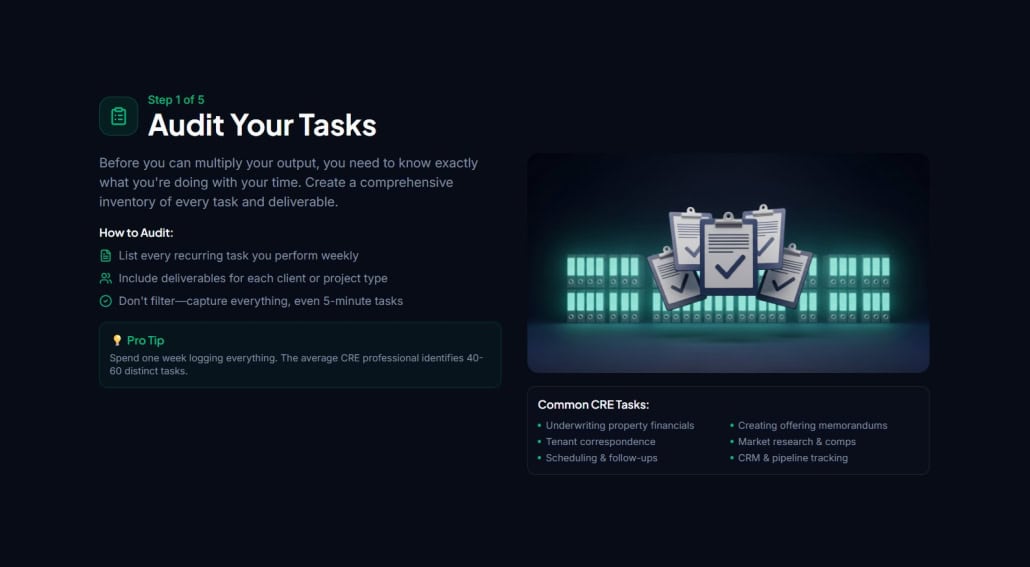
Step 1: Audit Your Work
Most of us describe our jobs in terms of deliverables, not tasks.
- Deliverables: “Quarterly report,” “IC deck,” “acquisition model,” “LOI,” “OM review”
- Tasks inside those deliverables: “Download OM,” “pull rent roll,” “extract unit mix,” “update debt terms,” “refresh charts,” “paste into PowerPoint,” “email the team”
When you say, “I build a model,” that is shorthand for 20 to 50 micro tasks.
What to do
For the next 6 weeks, keep a simple daily log:
- What deliverables did you work on today?
- For each deliverable, what tasks did you actually perform?
You can track this in a notebook, Excel, Notion, or directly in the Multiplier Framework app. The point is to start seeing your work as a collection of recurring tasks, not one big amorphous blob called “underwriting” or “asset management.”
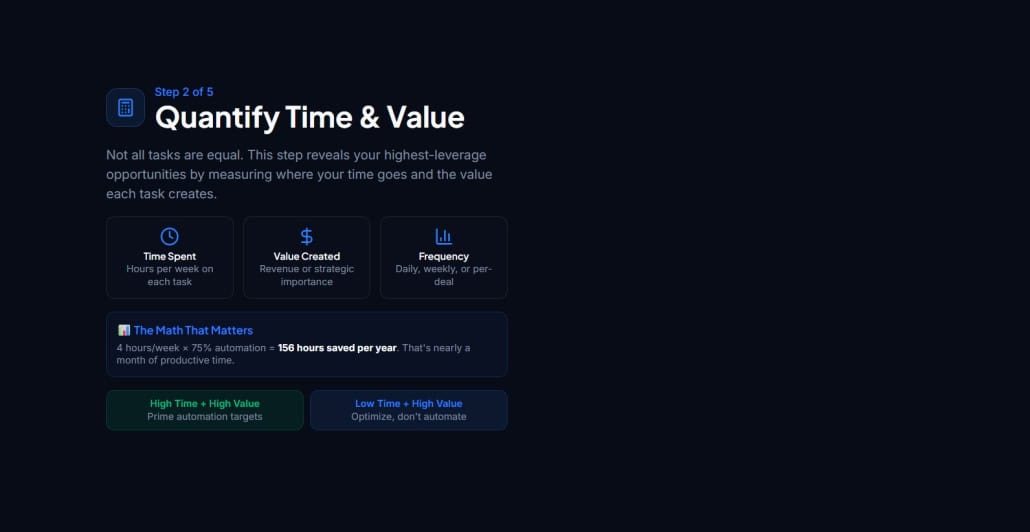
Step 2: Quantify the Impact
Next, you estimate the value of improving or partially automating each task.
Think in three categories:
- Time savings (hours per week or month)
- Revenue impact (fees, promote, commissions, deal volume)
- Cost impact (salary leverage, overhead, opportunity cost)
A few simple examples:
- If an analyst’s fully loaded cost is 50 per hour and they spend 50 hours per month on a recurring process, that is 2,500 per month. Cutting that in half saves about 1,250 per month.
- If closing a typical deal generates 100,000 in fees and a faster, more reliable process increases your win rate or compresses cycle time, you can attribute part of that value back to the underlying work.
This matters for everyone:
- Principals: Focus on revenue growth, margin, and risk reduction
- Employees: Improve bonuses, reviews, internal reputation, and long term market value
- Students: Become more competitive candidates by showing you can multiply output, not just complete assignments
In the app, you can assign value and frequency to each deliverable and let the math bubble up where the biggest multipliers really sit.
Step 3: Identify Solutions
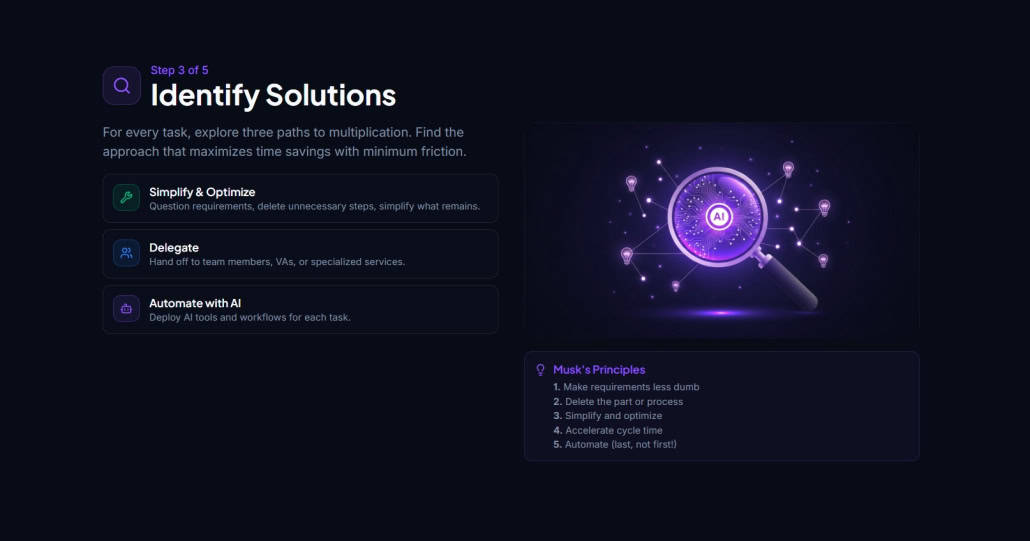
Once you have a ranked list of tasks, you can start brainstorming solutions.
Important nuance: Technology is not always the first or best answer.
A sequence I like:
- Make requirements less dumb
- Ask, “Do we actually need this?”
- “Does it need to be this detailed or this frequent?”
- Delete
- Many recurring tasks survive purely out of habit.
- Delegate
- To teammates, offshore help, vendors, or specialized services.
- Automate
- Only after you have simplified the task and removed the waste.
Quality problems usually come from:
- Picking the wrong tool for the job
- Expecting a generic chat to miraculously produce institutional quality work
- Not understanding what the tool needs from you to perform reliably
Inside the Multiplier Framework app, we started a library of third party AI tools plus a growing catalog of potential CRE Agents skills and custom patterns, so you are not starting from a blank page.
Step 4: Prioritize
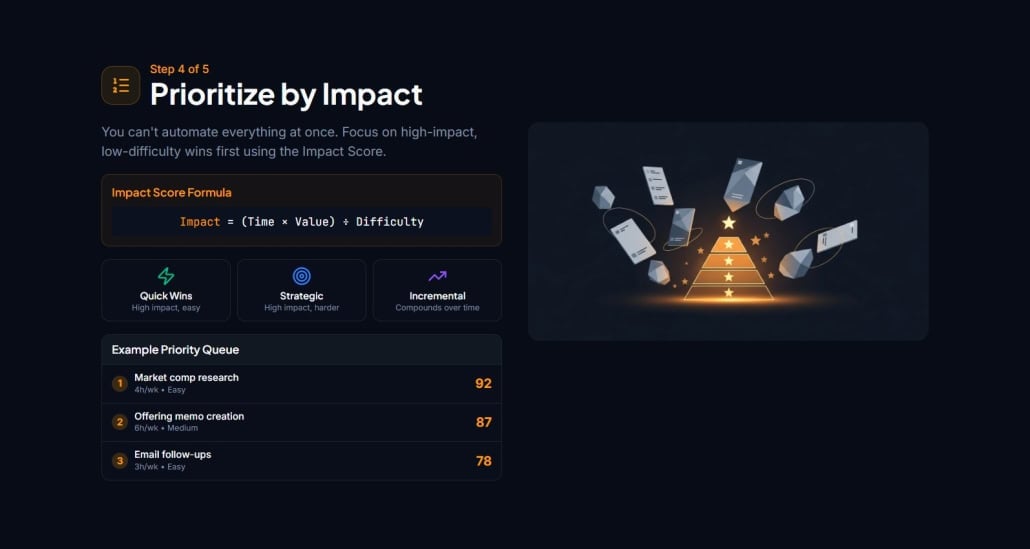
Now you decide where to start by looking at two simple variables:
- Impact: How much value could you create if this improved?
- Feasibility: How straightforward is it to implement the first version?
You do not need a complicated scoring system. Something like this is enough:
- High impact, easy to implement
- High impact, harder to implement
- Lower impact, easy
- Lower impact, hard
Start with high impact, easy to implement. That is how you avoid the “everything is important, so I do nothing” trap.
Step 5: Execute and Iterate
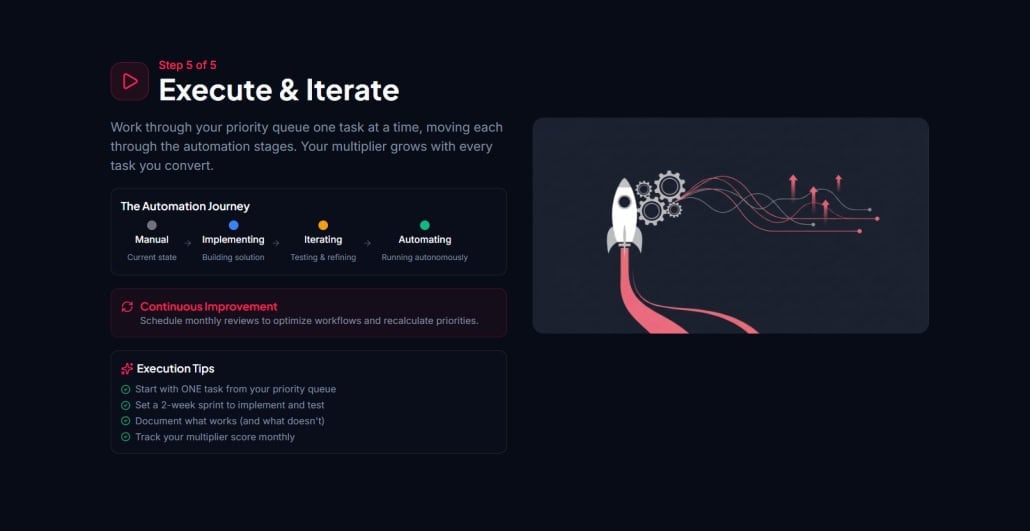
Finally, you pick one specific task and commit to improving it.
Think in three phases:
- Implement
- Sign up for the tool
- Wire up the integration
- Define the new workflow
- Iterate
- Test with real examples
- Refine prompts, filters, and handoffs
- Expect bugs and edge cases, that is normal
- Automate
- Once it runs reliably, treat it as handled
- Document it, then move on to the next target
A few mindset points:
- Do not wait for perfection. What you want at the start is incremental help, then you layer on improvements.
- Once Task 1 is in the “iterate” stage, you can introduce Task 2. Over time you build an assembly line of improvements.
You climb a mountain one step at a time. This framework is meant to show you where to place each next step.
A Real World Example of the Framework
In the workshop, I walked through a real example with Michael Belasco of Firm Ridge, an outdoor hospitality investment and development firm.
The core issue
- They were losing deals because their response time was too slow
- Michael believes they missed four ideal deals last year for this reason alone
- Initial fit checks took roughly 2 hours per deal
- Roughly 25 deals screened to get to 5 worth pursuing
- That is about 50 hours per month on initial screening
The solution path
- First, stand up a basic notification system so no deal goes unseen
- Next, layer in a simple pre screen based on property, geography, and basic parameters
- Over time, evolve toward a qualifying engine that scores and surfaces the best opportunities and eventually drafts simple starting points for responses
The key insight: a few years ago this would have required a developer, custom code, and ongoing support. Today, a non technical principal can get a minimum viable version running in under an hour using modern tools or something like CRE Agents.
That is the Multiplier Framework in practice: clear problem, quantified value, targeted solution, realistic first step.
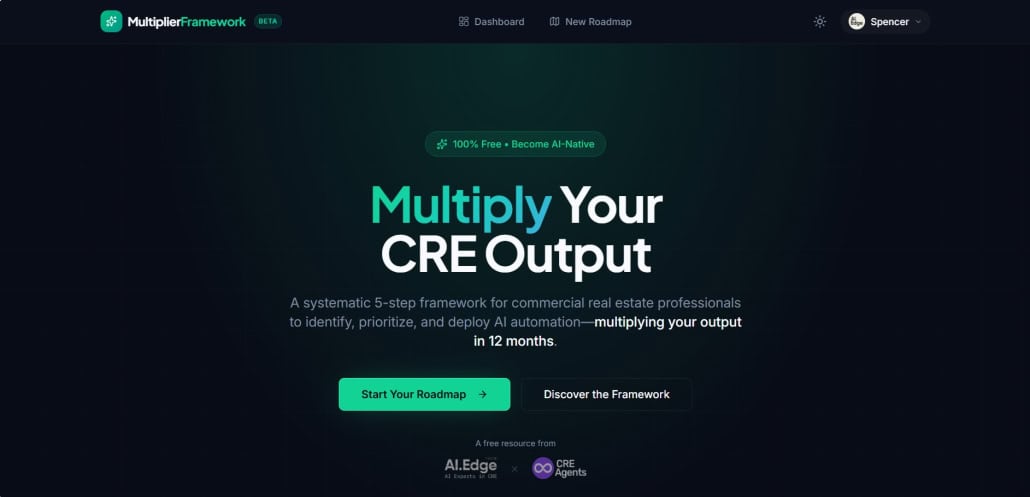
The Multiplier Framework App
To make all of this more tangible, we built a simple, free app around the framework:
👉 https://multiplier.adventuresincre.ai/
A few caveats:
- It was built by real estate people, not a large software team
- It is very much a version one
- Just like our early A.CRE Excel models, it will improve through many small iterations
What the app helps you do
- Roadmap: Define a specific process to improve, for example “Inbound lead to LOI, Q1 2026”
- Audit: List deliverables and tasks, and let AI suggest tasks you might be missing
- Quantify: Assign value and frequency, then see your biggest levers
- Identify: Browse example tools and patterns for solutions
- Prioritize: Rank tasks by impact or simply drag them into order
- Execute: Move work from Manual → Implementing → Iterating → Automated in a Kanban style board
- Dashboard: Track hours saved, time reduction, and your overall “multiplier effect”
My hope is that, at some point in the near future, a hiring manager in CRE will ask:
“What is your multiplier effect, and how did you build it?”
This framework and app are meant to help you answer that question with specifics.
Learn, Build, and Connect with AI.Edge and CRE Agents
When we polled the workshop audience on what was holding them back from using AI more effectively, the top three barriers were:
- 46%: “I do not know where to start.”
- 43%: “I do not trust the output.”
- 42%: “I have a skill gap.”
AI.Edge exists to close that gap on the education and community side:
- Programs and content designed specifically for acquisitions, development, asset management, and brokerage
- A community of peers who are experimenting, sharing wins and failures, and trading ideas
- Tools like the Multiplier Framework app and future resources for CRE professionals
You can learn more here: https://aiedge.ac
If you are a firm that wants help mapping processes, choosing a starting point, and actually building and deploying solutions, that is where CRE Agents comes in. Our team spends every day on:
- Process mapping and multiplier identification
- Designing and implementing AI coworkers and workflows for CRE teams
- Helping firms move from “AI experiments” to production use
You can learn more here: https://creagents.com
Your 2026 Challenge
My own output today is at least four times what it was before 2023. Given where the tools are now, I genuinely believe that doubling your output in 2026 is a realistic goal for almost everyone reading this.
This is not about having a computer science degree. It is about using a simple framework with consistency.
Here is my challenge to you:
- Map your work
- Use a notebook, a spreadsheet, or the Multiplier Framework app.
- Pick one task
- High impact, relatively easy to improve or automate.
- Do the first implementation
- Expect it to be imperfect on day one. That is fine.
- Move on to the second, then the third
- One task at a time. One small win at a time.
Do not wait for a perfect solution or a perfect moment. The technology is ready. The opportunity is in front of you.
Let us make 2026 the year you meaningfully multiply your output and start treating your time as your most valuable asset.
Frequently Asked Questions About The Multiplier Framework For CRE Professionals
The Multiplier Framework is a five-step process for CRE professionals to systematically increase their output using AI and automation. The steps are audit your work by breaking deliverables into individual tasks, quantify the impact of improving each task, identify solutions starting with simplification before jumping to technology, prioritize by impact and feasibility, then execute and iterate one task at a time. The goal is to treat your time as your most valuable asset and compress recurring work into a fraction of the time it takes today.
Over 70 percent of workshop attendees said they use AI only occasionally with no real system behind it. Most people still treat AI as a slightly smarter search engine or use it to draft the occasional email or memo. Meanwhile the tools have moved far ahead and can now monitor inboxes, parse offering memorandums and financials, trigger workflows, move data between systems, and draft and revise analysis as assumptions change. The gap is not the technology. It is not knowing where to start, not trusting the output, and not having a structured approach to adoption.
No. The framework is designed for any CRE professional regardless of technical background. The hard part is not the implementation. It is figuring out which work is worth multiplying. Once you know that, the solutions are much more approachable than people expect. A non-technical principal can get a minimum viable version of many solutions running in under an hour using modern tools.
Start by keeping a simple daily log for six weeks of what deliverables you work on and what tasks you actually perform inside each one. Then pick one task that is high impact and relatively easy to improve or automate. Do the first implementation, expect it to be imperfect on day one, and iterate. Once that first task is running reliably, move on to the second. You can use a notebook, a spreadsheet, or the free Multiplier Framework app to track your progress.
Before automating anything, the framework recommends a specific sequence. First ask whether the task actually needs to exist or be this detailed or frequent. Then delete tasks that survive purely out of habit. Then delegate to teammates, offshore help, or vendors. Only after you have simplified and removed waste should you automate. Quality problems usually come from picking the wrong tool, expecting a generic chat to produce institutional quality work, or not understanding what the tool needs from you to perform reliably.
In a real example shared during the workshop, a firm was losing deals because their response time was too slow, missing an estimated four ideal deals in one year. Initial fit checks took roughly two hours per deal across about 25 deals screened monthly. By applying the framework, they built a notification and pre-screening system that a non-technical principal got running in under an hour. The workshop host reports his own output today is at least four times what it was before 2023 and believes doubling output in 2026 is a realistic goal for almost any CRE professional.
The app helps you define a specific process to improve, list deliverables and tasks with AI suggesting ones you might be missing, assign value and frequency to see your biggest levers, browse example tools and solution patterns, rank tasks by impact, move work through stages from manual to implementing to iterating to automated on a Kanban style board, and track hours saved and your overall multiplier effect. It is free and available at multiplier.adventuresincre.ai.
CRE Agents helps firms move from AI experiments to production use. The team spends every day on process mapping and multiplier identification, designing and implementing AI coworkers and workflows for CRE teams, and helping firms turn the framework into real operational improvements across acquisitions, development, asset management, and brokerage.