

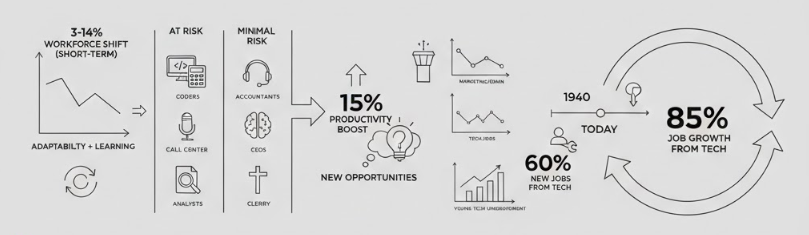
The conversation around artificial intelligence and employment has reached a critical juncture. According to analysis from Goldman Sachs Research, AI adoption could temporarily displace between 3% to 14% of the US workforce, depending on implementation speed and scope. However, this disruption tells only part of the story.
The research reveals that while AI could theoretically affect 6-7% of US workers if widely adopted, the impact is expected to be transitory rather than permanent. Historical patterns suggest that unemployment typically increases by only 0.3 percentage points for every 1 percentage point gain in technology-driven productivity growth, and this impact tends to disappear within two years.
The Jobs Most at Risk
The analysis identifies specific occupations facing higher displacement risk, including:
- Computer programmers
- Accountants and auditors
- Legal and administrative assistants
- Customer service representatives
- Telemarketers
- Proofreaders
- Credit analysts
Meanwhile, roles like air traffic controllers, chief executives, radiologists, pharmacists, and clergy members face minimal risk.
The Productivity Paradox
Goldman Sachs Research estimates that generative AI will raise labor productivity levels in developed markets by approximately 15% when fully adopted. This creates an interesting paradox: while individual roles may be displaced, the overall economic output could expand significantly, creating new opportunities we haven’t yet imagined.
Early Warning Signs
Some sectors are already experiencing AI’s impact:
- Employment growth in marketing consulting, graphic design, office administration, and telephone call centers has fallen below historical trends.
- Tech sector employment as a share of overall employment has decreased steadily since November 2022, falling below its pre-pandemic trajectory.
- Younger tech workers aged 20-30 have seen unemployment rise by nearly 3 percentage points since early 2025, suggesting entry-level positions face particular pressure.
The Historical Perspective
Perhaps most reassuring is the historical context: approximately 60% of today’s US workers are employed in occupations that didn’t exist in 1940. This suggests that more than 85% of employment growth over the past eight decades has come from technology-driven job creation. The pattern of technological disruption followed by new opportunity formation has proven remarkably consistent throughout modern economic history.
The Key Takeaway
AI will reshape work, but not eliminate it. The transition period will challenge workers and employers alike, but history suggests that adaptability and continuous learning will remain the most valuable skills in any technological era.
If you are in CRE and want to be on the right side of this shift, join the CRE Agents waitlist here: https://creagents.com
Frequently Asked Questions About AI And The Future Of Work
Research suggests the displacement is expected to be transitory rather than permanent. Historical patterns show that unemployment typically increases by only 0.3 percentage points for every 1 percentage point gain in technology-driven productivity growth, and that impact tends to disappear within two years. Approximately 60 percent of today’s US workers are employed in occupations that did not exist in 1940, meaning more than 85 percent of employment growth over the past eight decades has come from technology-driven job creation.
Roles with higher displacement risk include computer programmers, accountants and auditors, legal and administrative assistants, customer service representatives, telemarketers, proofreaders, and credit analysts. Roles like air traffic controllers, chief executives, radiologists, pharmacists, and clergy members face minimal risk. Early data also shows that younger tech workers aged 20 to 30 have seen unemployment rise by nearly 3 percentage points since early 2025, suggesting entry-level positions face particular pressure.